
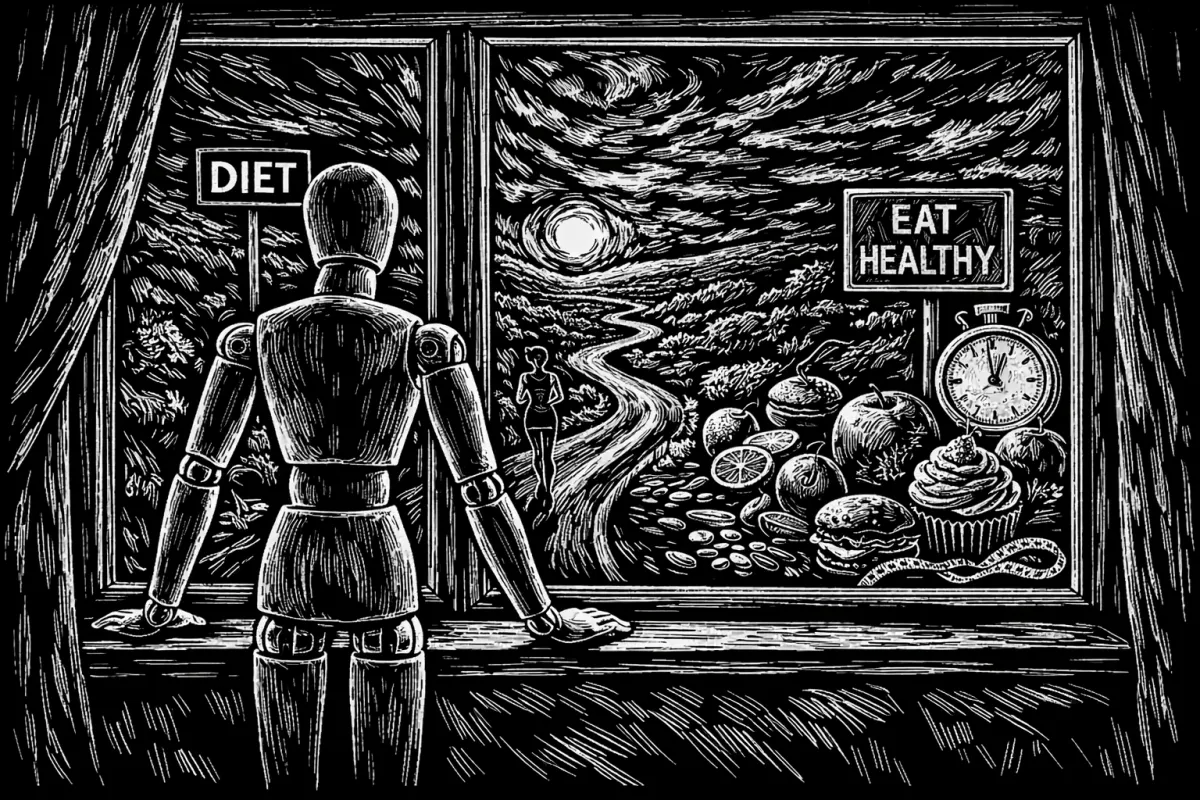
Why Can’t I Stick to My Diet? The Real Reason Diet Culture Keeps Failing You
If you've ever said to yourself:
"I know what I need to do in order to lose weight, I just can't seem to stick to it for some reason."
You're definitely not alone.
You probably start strong, feel focused, and follow through with the plan.
But then life always seems to happen.
Whether it's a bust week, stressful day, a missed workout, or a meal that wasn't "on your plan," something always seems to throw you off.
You're always either all in... or completely off.
What makes this even more frustrating is that you're not new to this either.
You've tried all the diets.
You've tracked your calories diligently.
You've followed all the rules.
You've proven you can be disciplined.
So, when you keep falling off the wagon, the question starts to come up:
Why can't I stick to my diet when I clearly care about my health and losing weight?
Most people will assume the answer is just a lack of discipline.
But it's not.
And the sooner you understand what's actually happening, the sooner this stops feeling like a personal failure and starts making sense.

IF YOU FEEL "GOOD ON A DIET" BUT LOST WITHOUT ONE, THIS IS WHY
A lot of people don't realize this, but feeling better ON a diet doesn't actually mean the diet is working.
It often just means it's doing all the thinking for you.
Diets can feel like a relief when food feels chaotic.
When someone (or something) is telling you:
Eat this.
Avoid that.
Stick to these numbers.
Decision making gets a whole lot easier.
And that's why you might notice:
You feel calmer when you're "on" a diet
You feel anxious when you are "off" the diet
You trust the diet way more than you trust yourself
Diets artificially reduce uncertainty.
And uncertainty increases anxiety.
So, anytime you decide to stop dieting or when you're forced to stop dieting (because no diet is designed for real life) you're not just losing structure.
You're losing the one thing that made eating feel safe for you.
That's why any sort of flexibility feels risky.
That's why rest days feel like you're failing.
And that's why "just listening to your body" sounds terrifying.
Not because you lack self-control.
Because that self-control has been borrowed NOT built.
WHY DIETS FEEL LIKE THE RIGHT CHOICE WHEN IT COMES TO LOSING WEIGHT (EVEN THOUGH THEY'RE NOT)
Diets feel effective in the beginning for a reason.
They create:
Clear boundaries
Simple decisions
Immediate feedback
A sense of identity
You're either "being good" or you're not.
You're either "back on track" or you're not.
And you're either "doing what you're supposed to do" or you're not.
That Identity matters.
Especially if part of how you see yourself is:
"I'm someone who tries to stay healthy."
So, when you're following what the diet is telling you to do, It reinforces that identity.
But the problem is what most diets DON'T teach you.
Most diets don't help you:
Build confidence with food
Adapt to unpredictable days
Respond calmly to slip-ups
Make decisions without pressure
They only work as long as the diet is intact.
But the moment real life interferes, the whole system collapses. And you're left feeling like YOU failed.
You didn't
You were just following an approach that only works in controlled conditions
And real life is never that controlled.
THE REAL REASON YOU CAN'T STICK TO YOUR DIET
If you've ever though to yourself, "I just need to be more consistent," I need you to read this next section carefully because the reason you can't ever stick to your diet isn't because you don't try hard enough.
It's because most diets rely on a form of control that isn't designed for real life.
Restriction Creates a False Sense of Compliance
Most diets are built around external rules.
Eat this.
Avoid That.
Stay within these numbers.
As long as you follow the rules, things feel "under control."
But here's the issue:
Rules don't build confidence.
They replace it.
When a diet works, if often works for you, not with you.
You're not learning how to:
Eat when plans change
Adjust when stress is high
Think logically if you overeat
You're just supposed to comply.
But when those rules disappear (even briefly) you're left without a skillset to fall back on.
That's not a character flaw on your part.
That's just the difference between following GPS directions and learning how to navigate the city.
One only works until the signal drops.
WHY MOTIVATION FALLS APART UNDER REAL LIFE
A lot of weight loss and dieting advice assumes discipline is just something you can turn up.
But motivation isn't infinite.
It's affected by:
Stress
Sleep
Emotional load
Mental fatigue
Decision volume
And dieting actually increases decision-making by making you think about stuff like:
What to eat
When to eat
Whether "you earned" it
Whether today still counts
That's a lot of mental effort.
This is also why things often fall apart:
During busy weeks
During travel
During emotional stress
When routines break
Not because you stopped caring but because the diet required more energy than you had available.
A diet that only works when life is calm isn't a sustainable one.
WHY THIS KEEPS FEELING LIKE A PERSONAL FAILURE
When a diet stops working, the diet never takes responsibility for it...
You do.
You think:
"I got lazy."
"I lost focus."
"I let myself slip."
But long-term diet adherence data shows that most people regain all the weight they lost (and sometimes more) after the decide to stop the diet.
Even when motivation is high.
That tells us something important:
This outcome isn't rare.
It's expected.
Which means blaming yourself doesn't make sense.
If thousands of people fall into the same pattern, the issue isn't individual discipline.
It's the model they were given.
WHAT THIS MEANS FOR YOU
If you've been stuck in the cycle of:
Start strong ➡️ fall of ➡️ restart ➡️ repeat
It doesn't mean you're never going to be able to lose weight and actually keep it off.
It means you were never taught how to build internal control.
And until that happens, every new diet will feel like relief at first... and failure later.
Not because you can't stick to it.
But because it was never designed to for your specific lifestyle.
WHY RESTRICTION OFTEN LEADS TO OVEREATING
This is usually the part people don't want to hear.
Because if you're afraid of gaining weight, the reality is that your diet might be part of the problem.
Your body and your brain respond to restriction in very predictable ways. And those responses get misinterpreted all the time.
Your Body Doesn't Experience Diets as 'Goals'
It experiences them as threats.
When you restrict food (physically or mentally) your body doesn't know you're trying to "be healthy."
It just knows the amount of available energy has changed.
And when the amount of available energy has changed, protective systems turn on.
That can look like:
Increased thoughts about food
Stronger cravings
Feeling "out of control" around certain foods
Eating past fullness after a slip
But it's important to understand that this isn't you sabotaging yourself or your body working against you.
It's compensation.
Your body is trying to restore balance.
The more rigid the restriction, the stronger the rebound tends to be.
That's why someone can feel completely "fine" while dieting... And then feel all over the place the moment the go off the diet.
Mental Restriction Matters Just as Much as Physical Restriction
A lot of people will say:
"But I wasn't even eating that little."
And while that might be true, restriction isn't just about how many calories you put in your mouth.
It's also about:
Labeling foods as "good" or "bad"
Feeling like certain foods aren't allowed
Savings calories for "later" so you can "enjoy yourself"
Needing to earn food through exercise
Feeling guilty after eating
Even when your intake looks "normal" on paper, mental restriction keeps things tense.
And the tension builds pressure.
That pressure will eventually have to go somewhere.
And that's typically what people call "losing control."
Why One Slip Always Turns into a Spiral
This is where the all-or-nothing mindset comes in.
You're on a diet. You break one rule. And instead of adjusting, your brain goes:
"Well, todays completely ruined now."
So you start eating whatever you feel like.
Not because you're hungry.
But because you already messed the day up so might as keep going right?
Now diet culture will make you think this is juts your lack of discipline showing up.
But it's actually how diets train you to think.
If success only exists inside the diet, then once the diet is gone, there's nothing holding things together.
That's why so many people don't just "get back on track" after a little slip up.
They wait tell the next day.
Or the next week.
And sometimes (if not most of the time) they'll wait tell the next latest and greats diet rolls around to get back on track.
Dieting doesn't teach you flexibility or sustainability.
It teaches compliance.
If Dieting Has Been the Only Thing Standing Between You and Your Inner Fat Kid,
then of course letting go of diet culture is going to feel dangerous and even scary.
Dieting has become your safety net.
So, When I'm sitting here telling you:
"You don't need to be that strict with your food,"
what you hear is:
"You just need to enjoy yourself more often."
And that's not at all what I'm saying (kind of).
All I'm saying is that if the only way you ever have control over your body is through restriction you'll never be able to lose the weight you want to lose and actually keep it off for good.
That only works for a short period of time.
But when it breaks, it breaks hard.
What's important to understand though, is that if when that approach does decide to break, and you are feeling like once you start, you want be able to stop...
That doesn't mean your weak or impulsive.
It just means you've been restricting for way too long.
Your body isn't betraying you.
It's just responding logically to a weight loss strategy that's created through extremes.
But the good news is... this response changes when our approach to weight loss changes.
Not by removing all your guardrails.
Buy by rebuilding them in a way that doesn't depend on restriction.
WHAT THE RESEARCH ACTUALLY SAYS ABOUT DIETING AND LONG-TERM ADHERENCE
When researchers look at dieting outcomes over time, a very consistent pattern tends to show up.
Not just in one study.
Not just with on type of diet.
But across decades of data
Most Diets Fail Long Term Even When People Try Hard
Larg-scale reviews of dieting research have found that the majority of people regain a significant portion of the weight they lose within a few years of dieting, and many regain more than they initially lost.
This isn't limited to one specific approach.
Low-carb.
Low-fat.
Calorie counting.
Point systems.
meal plans.
The pattern shows up again and again.
One of the most widely cited reviews in this area examined decades of dieting and concluded that long-term weight regain is the most common outcome (even among people who were motivated, compliant, and disciplined (Mann et al., 2007).
https://pubmed.ncbi.nlm.nih.gov/17469900/
Later analyses reinforce the same conclusion, noting that dieting outcomes tend to worsen over time, not improve, and that repeated dieting attempts often increase frustration and instability rather than solve the problem (Mann et al., 2015).
https://journals.sagepub.com/doi/10.1177/1745691615583125
That matters for one simple reason:
If most people struggle with long-term adherence, the issue can't just be individual discipline.
This Is Not a Motivation Problem
A common assumption is that diets fall because people "stop trying."
But research doesn't support that explanation.
In many studies, participants:
wanted to lose weight
Understood the plan
Initially followed it successfully
What changed wasn't their values.
What changed was their capacity to maintain the required level of control indefinitely.
Long-term weight maintenance research shows that sustained results are the exception, not the norm and that maintaining loss requires conditions that most people cannot realistically uphold forever (Aderson et al., 2001)
https://academic.oup.com/ajcn/article/74/5/579/4737411
This doesn't mean weight loss is impossible.
It means the method matters more than the intention.
Why This Information Is Often Misinterpreted
When people here "diets don't work," they often assume it means:
"Weight loss just isn't possible"
or
"Trying to lose weight is pointless"
That's not what the research is saying.
What it's saying is this:
Approaches that rely on prolonged restriction, constant self-control, and rigid rules tend to break down over time (especially when real life adds stress, unpredictability, and fatigue.
The outcome isn't suprising.
It's expected.
And once you understand that something important shifts.
What This means For You
If you've ever felt like:
"I can do this for a while, but I can't keep it up forever."
That deosn't mean you lack discipline.
It means you're responding normally to as system that demands more consistency than real life can reliably give.
The research doesn't point to the need for more pressure.
It points to the need for a different kind of structure.
One that:
Builds skills instead of dependence
Allows flexibility
Supports recovery
Holds up under stress
And that's where the conversation has to move next.
Not towards another diet.
But towards approaches that prioritize sustainability over intensity.
THE DIET HAMSTERWHEEL
Most people think their struggles with dieting are random.
They're not.
It follows a very predictable loop (and once you see it), you'll realize exactly where things keep breaking down for you.
Here's how it usually goes.
Step 1: The Reset
Something usually triggers you to start a new diet.
A photo.
A number on the scale.
A comment.
That underlying feeling of, "I need to get it together."
So, you decide:
"This time I'm serious."
You pick a diet.
You set the rules.
And you feel a sense of relief almost immediately.
Not because the diet is perfect but because all your uncertainty is gone.
Step 2: The Diet High
The first phase usually feels good.
You're:
Focused
Motivated
Clear on what to do
You're not thinking about food as much because decisions are made for you.
This is usually the part people point to when they say:
"See? I can stick to things when I try."
And they're right.
But this phase is fueled by:
Novelty
Motivation
External structure
Not sustainability.
Step 3: Cognitive Fatigue Sets In
Over time, the mental load of constantly being on a diet starts to creep up.
Even if the diet is "simple," it still requires:
Constant monitoring
Ongoing restraint
Daily decision-making
Emotional regulation
Life doesn't pause while you diet.
Work gets busy.
Stress builds up.
Sleep drops.
And social events happen. The diet doesn't adjust... but you capacity does.
This is usually when people start saying:
"IDK what's wrong with me lately."
Nothing's wrong, your system is just getting tired.
Step 4: The First Slip Up
Eventually, something breaks...
A meal out.
A missed workout.
An emotional day.
An unplanned snack.
Objectively, these a minor.
But subjectively, they feel big because of the rules the diet has put into place.
This is what most diets don't prepare you for.
Step 5: The F*ck It Moment
Instead of adjusting, you brain just flips a switch.
"Sense I already mess up, I might as well..."
So you eat more.
Not really because you want to.
But because (in your head) the day no longer counts.
This is where you start to feel out of control and it can feel kind of scary (especially if you're someone who values discipline).
Step 6: Shame Takes Over
Afterward comes the self-talk.
"What's wrong with me?"
"I always do this."
"I knew I couldn't trust myself."
Shame makes getting back on track even harder now.
And instead of getting back on the wagon, you just end up pulling away completely.
Step 7: Abandonment
At this point, dieting feels pointless.
You stop tracking.
You stop paying attention to your food.
And you tell yourself you'll try again some other time.
Bu this is were the rebound always happens.
Not because you don't care about your health but because you became dependent on the diet to hold everything together for you.
Step 8: The Next Diet
Eventually, discomfort builds again.
And the cycle starts all over.
New diet.
New rules.
Same outcome.
Most People Think the Problem Is Step 5
The overeating and loss of control.
It's not.
The real problem is that nothing in this cycle teaches:
How to adjust mid-day from a slip up
How to respond to changes without shame or guilt
How to stabilize instead of restart completely
And how to continue making progress regardless of how perfect you are
Because of this:
Every slip becomes a restart
Every restart becomes a new diet
And every new diet recreates the cycle
But Once You Understand This Pattern, Something Important Changes
You stop asking:
"What's wrong with me?"
And you start asking:
"What kind of approach would prevent this cycle from happening at all?"
That's the question that's going to lead to real change for you.
WHY THE "JUST BE MORE CONSISTENT" ADVICE NEVER WORKS
At some point, almost everyone hears this advice during their weight loss journey:
'You just need to be more consistent."
And I mean, it sounds reasonable.
But if you're someone who already cares about your health, it can hit pretty hard because it implies you're actively choosing not to follow through.
But here's the problem.
Consistency isn't a personality trait.
It's an outcome of a weight loss approach that fits your lifestyle.
Telling someone (or yourself) to just "be more consistent" without changing the approach they're using is like telling someone to breathe harder underwater.
Effort isn't the issue.
Environment is.
CONSISTENCY REQUIRES CAPACITY NOT JUST INTENT
Most people think consistency comes from wanting it badly enough.
It doesn't.
Consistency depends on:
How many decisions you have to make
How much stress you're under
How much margin for error you have in your day
How forgiving your diet is when things go sideways
If a diet only works when:
Your well-rested
Life is calm
Motivation is high
Nothing unexpected happens
Then it's not a consistency problem.
It's a design problem.
WHY DIETS COLLAPSE EVERYTIME LIFE GETS BUSY
Busy weeks expose weak systems.
When work piles up.
When sleep drops.
When emotional load increases
That's when people say:
" I don't know why I can't just stick to it."
But here's what actually happening:
Your brain is prioritizing survival, not optimization.
Dieting adds extra cognitive load:
Tracking.
Restricting.
Monitoring.
Correcting.
When your mental bandwidth shrinks, the first thing to go is the system that requires the most effort.
That doesn't mean it wasn't important.
It just means it wasn't resilient enough.
WHY SHAME MAKES CONSISTENCY WORSE
When people struggle to stick to a diet, they often respond by tightening the rules.
More structure.
More restriction.
More pressure.
But shame doesn't create consistency.
It creates avoidance.
The more a diet feels like a test of your worth, the harder it becomes to re-engage after a slip up.
That's why people disappear after falling off.
That's why they delay restarting.
That's why weekly resets feel safer than mid-week adjustments.
Shame make consistency feal heavy.
And heavy things usually always get dropped.
WHAT ACTUALLY SUPPROTS CONSISTENCY
Consistency isn't about doing things perfectly.
It's about:
being able to continue after imperfect days
Having default behaviors when motivation dips
Using structure that adapts instead of breaks
Reducing decisions instead of multiplying them
The most consistent people aren't more motivated than everyone else.
They're actually less dependent on motivation.
And their systems do more of the work for them.
If you've been trying to "be more consistent" for years with the same result, the issue isn't that you haven't learned your lesson yet.
It's that you've just been trying to learn the wrong lesson.
You don't need more motivation. You don't need more rules. And you don't need another diet.
You just need a way of approaching food and exercise that still works even when life is a little crazy.
WHAT ACTUALLY CREATES WEIGHT LOSS RESULTS (WITHOUT DIETING)
If dieting hasn't worked for you in some time now, most people assume the alternative is to go in the complete opposite direction.
No rules.
No structure.
Just "eat intuitively," train when you feel like it, and hope for the best.
That's not what I'm talking about here either.
Letting go of diet culture does not mean letting go of everything entirely.
It means changing where your results come from.
Results Built on Restriction Are Fragile
Restriction-based control over your food works like this:
As long as the rules are intact, you feel steady.
The moment they bend, everything feels at risk.
That's why restriction feels so all-or-nothing.
That kind of control requires constant effort.
And constant effort is the first thing to go when life gets busy.
Real Results Come from Predictability You Can Maintain
Sustainable weight loss results don't come from whit-knuckling your way through diet and exercise.
They come from knowing:
What you'll do on a normal day
What you'll do when things aren't perfect
How to eat without fear or anxiety
How to respond without spiraling out of control
In other words, it comes from competence, not compliance.
When you trust yourself to respond accordingly, you don't need extreme rules just to feel on track.
Dieting Teaches You How to Follow Instructions
I'm teaching you how to navigate situations.
One depends on conditions being ideal.
The other holds up when conditions change.
That's why people who build the proper skills and habits don't feel "on edge" when plans changes.
They just adjust and keep moving forward.
WHAT THIS LOOKS LIKE IN PRACTICE
This kind of approach to weight loss isn't flashy.
It looks like:
Eating consistently even when meals aren't perfect
Missing a workout without feeling like you're failing
Having a higher-calorie day without needing to compensate for it later
Making decisions without panic or guilt
Nothing dramatic.
Nothing extreme.
Just steady, consistent progress that lasts.
Why This Will Feel Uncomfortable at First
If you've relied on dieting for a long time to help you lose weight, this shift can feel unsettling.
You're no longer outsourcing control to aa diet.
You're rebuilding it internally.
That takes time.
And it requires structure that supports learning.
This is where most people get stuck.
They don't need less structure.
They just need a better one.
Structure that:
Reduces decision fatigue
Builds confidence gradually
Allows flexibility without collapse
Supports progress without intensity
That's the difference between dieting and building a health and fitness approach you can live with.
WHAT THIS LOOKS LIKE IN REAL LIFE
Most diets look good on paper but then fall apart real fast once life decides it wants to happen.
Because real life includes things like:
Busy work weeks
Social events
Low-energy days
Missed workouts
Emotional stress
Meals that aren't ideal
A sustainable weight loss approach doesn't pretend those things won't happen.
It's built around them.
On a Normal Week
Instead of trying to be perfect, the focus is predictability.
You're not asking:
"How do I eat flawlessly?"
You're asking:
"What's a baseline I can repeat?"
That might look like:
Eating similar meals most days
Having default options, you don't overthink
Training in a way that fits your schedule
Making progress without constant adjustment
Nothing fancy.
Just steady enough that you don't need to "get back on track" every Monday.
When Life Gets Busy
This is where most diets collapse.
A sustainable approach to weight loss does the opposite.
When things get hectic, the goal isn't to push harder.
It's to simplify.
That might mean:
Fewer food decisions
Shorter workouts
Maintaining instead of progressing
Prioritizing consistency over optimization
You're not failing here.
You're adapting.
That ability to adapt is what keeps momentum alive.
When You Miss A Workout
In diet culture, missed workouts can trigger thoughts like:
"I'm falling behind."
"I'm losing progress."
"I'm being lazing."
In reality, missed workouts are just part of the process.
An approach to weight loss that works long term:
Expects missed workouts
Plans for them
Doesn't require compensation
Doesn't tie them to food choices
You don't need to "make up for them."
You just keep going.
That's what sustainable weight loss actually looks like.
When You Eat More Than Planned
This is a big one.
In restrictive diets, higher-calorie days feel very dangerous.
They trigger panic, tightening or the rules, and the urge to restart ASAP.
But inside a more sustainable approach to weight loss, they're just information.
You don't punish yourself for them.
You don't restrict because of them.
You just stay stable.
That might mean:
Eating normally at the next meal
Getting back to your usual routine
Not changing anything to dramatically.
Progress isn't erased by one off meal or even by one off day.
But it is protected by what you do AFTER that.
WHY THIS BUILDS TRUST OVER TIME
Every time you:
Recover without restarting
Eat flexibly without losing control
Miss a workout without spiraling into hours of cardio
Stay consistent without needing to make up for something you did wrong
You prove something important to yourself.
"I don't need extreme diets to see progress."
That belief is what people are actually chasing when they diet.
Not a number on the scale or perfection.
Just Stability.
At some point, something subtle changes though
You stop thinking about food all day.
You stop feeling like health requires constant effort.
You stop feeling one mistake away from failure.
But not because you don't care about your health anymore.
You've just built a weight loss approach that doesn't collapse every time life decides to throw a curve ball at you.
HOW MUCH STRUCTURE DO YOU ACTUALLY NEED?
One of the biggest mistakes people make after realizing dieting doesn't work is swinging to the complete opposite extreme.
The go from needing all the rules to stay consistent to thinking they can just go off and all the sudden be able to do this on their own.
But that jump is usually too big.
And when it ends up not working, it just reinforces the same old belief that dieting is the answer.
But the truth is a lot simpler that that.
You don't need no structure.
You just need the right amount of structure for where you are.
Structure isn't The Problem
Misaligned structure is.
Structure becomes a problem when it:
Requires constant effort
Punishes imperfection
Collapses when life gets busy
Makes you feel one mistake away from failure
But structure that:
Reduces decisions
Builds confidence gradually
Allows flexibility
Supports recovery
That's what creates Sustainable results.
The goal isn't to remove support altogether.
It's to use the correct amount of support intelligently.
Think of Structure as a Scaffolding
If someone breaks their leg, you don't tell them:
" You shouldn't need crutches."
You give them the level of support that lets them heal and move forward.
As strength returns, the support changes.
Nutrition and exercise work the same way.
Some people need:
A clear training plan
Simple nutritional guardrails
Minimal check-ins
Other need:
More guidance
Accountability
Help navigating stress, routines, and setbacks
Needing more structure doesn't mean you're worse of then everyone else.
It just means you're honest about your capacity.
The Question to Ask Yourself
Instead of asking:
"Should I be able to do this alone by now?"
Ask:
"What level of support would help me stay consistent without burning out?"
That question will lead to better decisions, and it removes the shame from getting help.
HOW THE SIMPLYFIT COACHING PROGRAMS SUPPORT YOUR WEIGHT LOSS GOALS (WITHOUT DIETING)
Everything you've read so far is the exact philosophy behind how I coach my clients.
No dieting.
No extremes.
And no more starting over every few weeks.
The goal anytime I work with a client is simple:
Help you build a weight loss approach that produce sustainable results for you WITHOUT creating so much pressure you can't sustain it.
That means:
No rigid food rules
No earning food through exercise
No punishment for imperfect weeks
No expectation that life needs to calm down first
Instead, we focus on:
Creating predictable routines in your schedule
Habit building around food
training that improves your quality of life
Structure that adapts when things get busy or messy
CHOOSING THE RIGHT PROGRAM FOR YOU
There isn't a "best" option here.
There's just the option that fits your current capacity.
If You Mostly Need Structure Around Your Training
If nutrition already feels mostly under control but your workouts feel inconsistent, random, or overwhelming, this level gives you:
Clear, repeatable training programs
Flexibility around schedule and equipment
Progress without overthinking it
Community support without all the pressure
This works well if:
You want structure not micromanagement
You're tired of guessing what to do in the gym
You want training to support your life, not dominate it
If You Need Guidance with Food and Accountability
If you know what to do but struggle to stay consistent (especially when life gets busy) this level adds:
Personalized nutrition guidance
Simple food structure that's doable
Regular check-ins to adjust without restarting
Accountability without all the shame that usually comes with other weight loss approaches
This works well if:
You're tired of doing this alone
You want help staying consistent
You value sustainability over speed
If You Feel Stuck and Don't Trust Yourself Yet
If you've tried everything and still feel like something deeper keeps pulling you off track, this level offers:
1:1 coaching
High-touch support trough complex situations
Help rebuilding trust with food and your body
A plan that adapts fully to your lifestyle
This works well if:
You feel like nothing has worked long term
You're exhausted from starting diet after diet
You want someone in your corner handing your hand through the entire process
No matter which level you choose, the goal is the same:
To help you stop dieting and start living.
You don't need to be miserable just to lose weight.
You just need the right plan that's going to work with your lifestyle instead of against it.
Sources & Research
Mann et al., 2007 – https://pubmed.ncbi.nlm.nih.gov/17469900/
Mann et al., 2015 – https://journals.sagepub.com/doi/10.1177/1745691615583125
Polivy & Herman, 1985 – https://pubmed.ncbi.nlm.nih.gov/4014232/
Lowe & Levine, 2005 – https://pubmed.ncbi.nlm.nih.gov/16076989/
Baumeister et al., 1998 – https://pubmed.ncbi.nlm.nih.gov/9637261/
Adams & Leary, 2007 – https://pubmed.ncbi.nlm.nih.gov/17362509/
Fairburn et al., 2003 – https://pubmed.ncbi.nlm.nih.gov/14522245/
Lally et al., 2010 – https://onlinelibrary.wiley.com/doi/10.1002/ejsp.674